Key takeaways
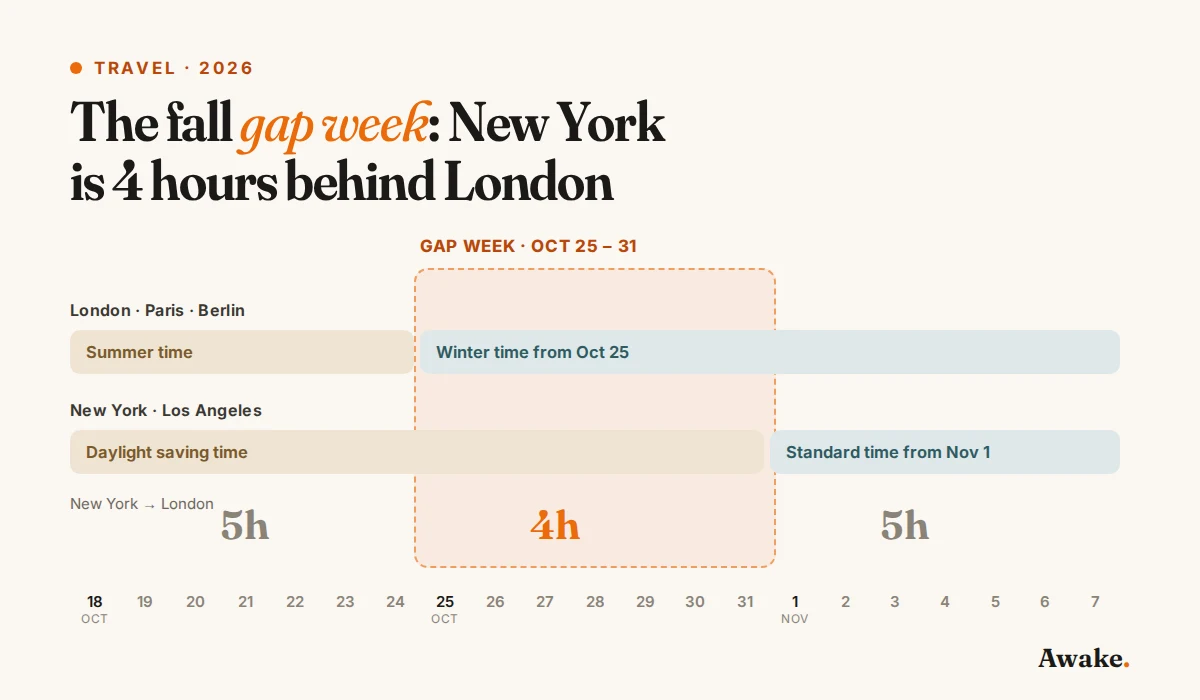
- Europe ends summer time on the last Sunday of October (October 25, 2026); the US ends daylight saving time on the first Sunday of November (November 1, 2026).
- For the week in between, New York is 4 hours behind London instead of 5, and Los Angeles is 7 hours behind instead of 8.
- Calendar apps adjust events that carry a time zone. The mistakes happen with times typed into emails, chats and plans from memory.
Every year, for about a week, a lot of transatlantic meetings start an hour “early”. Nobody moved them. The continents simply turned their clocks back on different Sundays.
Quick answer
Europe ends summer time on the last Sunday of October. The United States ends daylight saving time on the first Sunday of November. In 2026 those dates are October 25 and November 1, so for seven days the usual gaps shrink by an hour: New York is 4 hours behind London instead of 5, and 5 hours behind Paris instead of 6.
Two continents, two rulebooks
The clocks are not changed by habit. Each side follows a written rule, and the two rules point to different days.
In the European Union, the dates come from Directive 2000/84/EC. Summer time ends on the last Sunday of October at 01:00 UTC — the same instant everywhere, which is 02:00 in London and 03:00 in Paris and Berlin. The UK changes at the same moment.
In the United States, the rule comes from the Energy Policy Act of 2005. Since 2007, daylight saving time has started on the second Sunday of March and ended on the first Sunday of November, at 2 a.m. local time. That means the US doesn’t even switch all at once: New York changes first and Los Angeles three hours later.
Not everyone switches. NIST lists Hawaii and Arizona (except the Navajo Nation) among the places in the US that stay on standard time all year. In Asia, South Korea and Japan don’t use daylight saving time at all.
The 2026 dates
| Where | Clocks change | What happens |
|---|---|---|
| Sydney | Sunday, October 4 | Forward one hour (Southern Hemisphere spring) |
| UK and EU | Sunday, October 25 | Back one hour at 01:00 UTC |
| Most of the US | Sunday, November 1 | Back one hour at 2 a.m. local time |
| Arizona, Hawaii | No change | Standard time all year |
| South Korea, Japan | No change | No daylight saving time |
Dates calculated from the IANA Time Zone Database, which phones and computers use to set their clocks.
What the gap week does to familiar time differences
Here is how the hours between common city pairs move across October and early November 2026.
| City pair | Oct 4 – 24 | Oct 25 – 31 | From Nov 1 |
|---|---|---|---|
| New York → London | 5 h | 4 h | 5 h |
| New York → Paris | 6 h | 5 h | 6 h |
| Los Angeles → London | 8 h | 7 h | 8 h |
| London → Seoul | 8 h | 9 h | 9 h |
| New York → Seoul | 13 h | 13 h | 14 h |
| London → Sydney | 10 h | 11 h | 11 h |
Two things stand out. The New York–Europe gaps dip for one week and come back. The gaps to Seoul and Sydney don’t come back: they jump once when Europe changes and once when the US changes, because those cities aren’t moving their clocks on either date. London and Sydney are 9 hours apart at the start of October and 11 hours apart by the end of it.
Why the rules drifted apart
For a while, the fall dates matched. The U.S. Naval Observatory notes that from 1987 the US ran daylight saving time from the first Sunday in April to the last Sunday in October — the same Sunday Europe used to end summer time.
The Energy Policy Act of 2005 changed both ends. Starting in 2007, the US moved the start several weeks earlier and the end one week later, to the first Sunday in November. Europe kept its rule, and the fall gap week has been on the calendar ever since. NIST describes the goal of the change as saving energy, with daylight saving time now covering about 238 days a year.
The spring version is three weeks long
The same mismatch happens in March, and it lasts longer. In 2026 the US moved its clocks forward on March 8 and Europe followed on March 29. For those three weeks, New York was again 4 hours behind London.
Where people actually get caught out
Calendar invites usually survive the gap week. An event created with a time zone attached — say, 10:00 New York time — is converted for each person. During the gap week it simply appears at 14:00 in London instead of 15:00.
The trouble comes from times that live outside the calendar:
- Times typed as text. “Call at 3 p.m. your time” in an email or chat thread has no time zone attached, and the person reading it may convert it with last week’s gap.
- Recurring habits. If you always join the New York team’s 11:00 standup at 16:00 London time, you’ll be an hour late during the gap week.
- Mental math from memory. “London is five hours ahead” is true for most of the year, which is exactly why nobody double-checks it.
Common mistakes
- Assuming the US and UK change on the same night. They don’t in the fall, and in spring they are three weeks apart.
- Converting with a fixed number of hours for Asia–Europe or Asia–US meetings. Those gaps change on two different dates.
- Forgetting that Arizona and Hawaii don’t change, so their gap to New York changes on November 1 too.
Will this ever stop?
Not yet. In 2018 the European Commission received about 4.6 million responses to a public consultation, and 84% of respondents wanted to stop changing the clocks. The European Parliament voted in March 2019 to end the seasonal change, but the proposal still needs the approval of EU governments, which have not agreed on whether to keep permanent summer or permanent winter time. Until something changes in law, expect the gap week every fall and the three-week gap every spring.
Questions people ask
Does the UK change its clocks on the same day as the EU?
Yes. In 2026 the UK and EU countries go back one hour at the same moment, 01:00 UTC on Sunday, October 25 — one week before most of the US.
Is there a gap in spring too?
Yes, and it is longer. The US starts daylight saving time on the second Sunday of March (March 8, 2026) and Europe on the last Sunday of March (March 29, 2026), so for three weeks New York is four hours behind London.
Why does the gap to Seoul or Tokyo change on two different days?
South Korea and Japan don't use daylight saving time. Their gap to London changes when the UK changes (October 25), and their gap to New York changes when the US changes (November 1).
Will Europe stop changing the clocks?
The European Parliament voted in 2019 to end seasonal clock changes, but the plan also needs agreement from EU governments, and that has not happened. For now the twice-a-year change continues.
If a time crosses the Atlantic in late October or March, check it on the day — not from memory.