Key takeaways
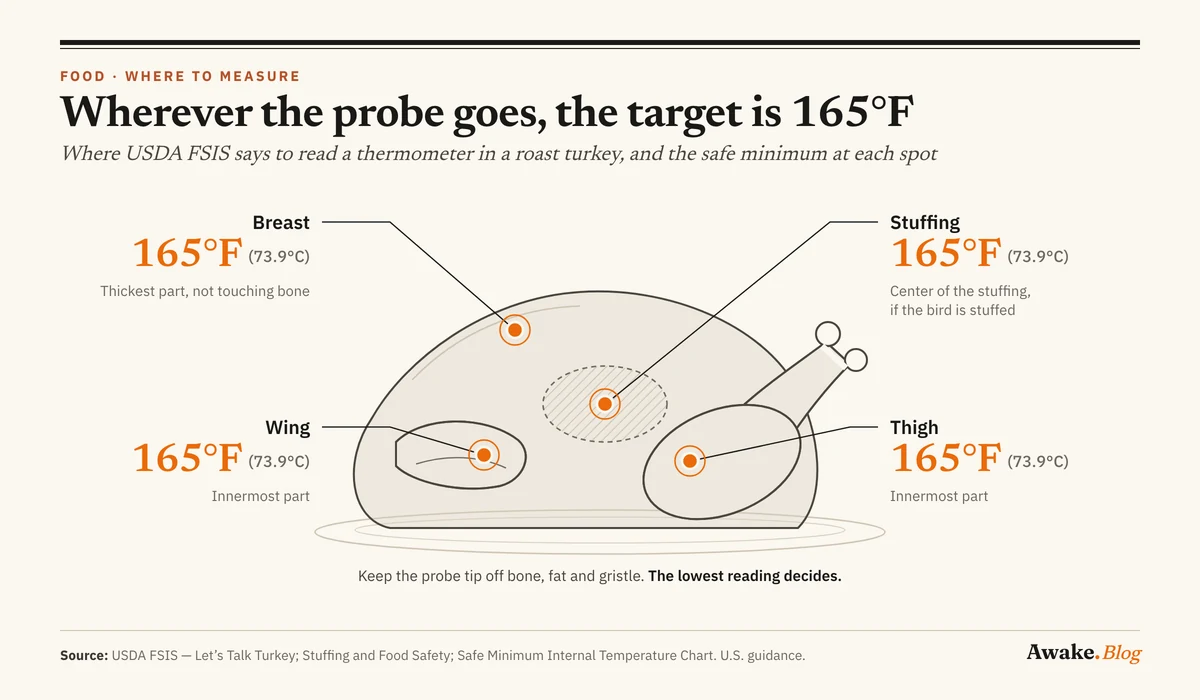
- USDA FSIS lists 165°F (73.9°C) for all poultry, including a whole turkey and its stuffing, read in the breast, the innermost thigh and the innermost wing.
- The single 165°F figure dates to April 2006 and rests on NACMCF advice; CIDRAP reported earlier federal figures of 180°F for whole chickens and 170°F for breasts.
- Health Canada still lists 82°C (180°F) for whole poultry and 74°C (165°F) for pieces and stuffing, and its chart gives no reason for the split.
The probe in the breast reads 165°F. The recipe card, copied from a family cookbook long ago, says to keep roasting until 180°F, and the side dishes are cooling on the counter. A cook in Canada checking the government chart would find 180°F there as well, but only for a whole bird; turkey pieces are listed at 165°F. The 165°F on the probe is the current U.S. figure for every part of the bird. The 180°F on the card matches the old U.S. whole-bird figure, dropped in 2006, which Canada still uses for birds roasted whole.
Quick answer
Yes. USDA’s Food Safety and Inspection Service (FSIS) lists 165°F (73.9°C) as the safe minimum internal temperature for all poultry, including a whole turkey, its thighs and wings, and the stuffing. Check the thickest part of the breast, the innermost thigh and the innermost wing, away from bone. The 180°F figure reflects older U.S. whole-bird advice, replaced in April 2006. Health Canada still lists 82°C (180°F) for whole birds and 74°C (165°F) for pieces.
How 180°F turned into 165°F
In April 2006, USDA announced that 165°F was the key temperature for poultry safety. CIDRAP, the University of Minnesota’s infectious-disease news service, reported the change on April 5 of that year. Earlier federal recommendations, CIDRAP’s article said, had included 180°F for whole chickens and 170°F for breasts. The new guidance replaced those tiers with one number for all poultry.
CIDRAP’s article names chickens and gives no separate turkey figure. One likely reason a turkey recipe calls for 180°F is that it follows that older whole-bird number, or Canada’s current chart.
According to CIDRAP, the change was based on advice from the National Advisory Committee on Microbiological Criteria for Foods, known as NACMCF. The committee adopted its response to questions from FSIS on March 24, 2006. The Journal of Food Protection published it in January 2007.
CIDRAP’s article said the reasoning centered on Salmonella, which it described as the most heat-resistant pathogen of public health concern in raw poultry. The article added that 165°F is also lethal for Campylobacter and for avian influenza viruses.
The NACMCF report, as quoted by CIDRAP, left room for higher numbers. It said higher final temperatures may be needed for consumer acceptability and palatability, such as removing a pink appearance or a rubbery texture. Palatability means how pleasant the food is to eat. USDA, in the same CIDRAP article, added that consumers may choose higher temperatures for personal preference.
So taking the legs or thighs past 165°F is a texture choice. The safety minimum stays at 165°F either way.
Where the probe goes, and what it replaces
The FSIS turkey roasting guide calls for three readings. They go in the thickest part of the breast, the innermost part of the thigh and the innermost part of the wing. The probe should not touch bone, fat or gristle. FSIS treats poultry as safe once all parts reach at least 165°F, so the lowest of the three readings is the one that counts.
Health Canada words the placement a little differently: “through the thickest part of the meat, all the way to the middle, not touching any bone.” For a whole bird, its poultry safety page points to the thickest part of the breast.
FSIS rules out two familiar shortcuts by name, and a third rests on the same judgment of color:
- The pop-up timer. FSIS advises checking with a food thermometer even after a built-in timer has popped.
- Pink meat. FSIS says color is not a reliable safety signal. Pink can remain in properly cooked poultry, and meat that stays pink is safe once every part has reached at least 165°F.
- Clear juices. Juices are judged by eye, too. By the same logic as FSIS’s point on color, a clear run of juice is no substitute for a thermometer reading.
Britain’s Food Standards Agency (FSA) takes a different line on color. Alongside its temperature rule, it tells cooks to check that no meat is pink and that the juices run clear. The two agencies agree on measuring the thickest part. They differ on whether color is a useful second check.
Canada splits whole birds from parts
Health Canada’s safe cooking temperatures chart, published June 4, 2024, lists whole poultry, including turkey, at 82°C (180°F). Pieces and ground poultry are listed at 74°C (165°F). So is stuffing, whether cooked alone or inside the bird. The poultry safety page repeats the whole-bird rule: the thickest part of the breast should reach 82°C (180°F).
The chart gives no reason for the difference. It does show where the split falls: between whole birds and parts, not between Canadian and American turkeys. A turkey breast roasted by itself appears to fall under pieces on the chart, which would give it the same 165°F target that FSIS uses. The 180°F applies when the bird goes into the oven whole.
In Celsius, 165°F works out to 73.9°C, which Canada writes as 74°C, and 180°F works out to 82.2°C, written as 82°C. For a whole turkey, that leaves the two countries 15°F apart.
Britain writes the rule as a time-and-temperature table
The FSA’s Christmas food hygiene guidance gives no single figure. The thickest part of the turkey must reach one of five time-and-temperature pairs: 60°C for 45 minutes, 65°C for 10 minutes, 70°C for 2 minutes, 75°C for 30 seconds or 80°C for 6 seconds. In a whole bird, the FSA says, the thickest part is the area between the leg and the breast.
That makes the British rule a different style from the American one. Under the FSA’s list, 70°C held for 2 minutes meets the same requirement as 80°C held for 6 seconds. FSIS’s consumer chart, by contrast, gives poultry a single temperature to read on a thermometer. The British schedule shows how the UK writes its rule; it is not a U.S. recommendation.
| Where | Target temperature | Where to measure | Source |
|---|---|---|---|
| U.S., whole bird, parts and stuffing | 165°F (73.9°C) | Thickest part of breast, innermost thigh, innermost wing; stuffing center | USDA FSIS |
| Canada, whole bird | 180°F (82°C) | Thickest part of the breast | Health Canada |
| Canada, pieces and stuffing | 165°F (74°C) | Thickest part, not touching bone | Health Canada |
| UK | No single number: 70°C (158°F) for 2 min is one option; 75°C for 30 s or 80°C for 6 s also qualify | Thickest part, between leg and breast | Food Standards Agency |
U.S. figures from current FSIS pages; Health Canada chart published June 4, 2024; FSA guidance on GOV.UK, 2026.
Stuffing inside the bird is the slow part
FSIS says the center of the stuffing must reach 165°F, and the stuffing should not come out of the bird before it does. Its advice is to cook stuffing separately.
Health Canada puts the difficulty plainly: stuffing is “moist and slow to heat up and cool down.” That is why a breast reading of 165°F does not settle the question for a stuffed bird. The center of the cavity may not have caught up yet, so it needs its own reading.
Canada’s instructions follow its own two numbers. Its poultry page says to remove the stuffing as soon as the whole bird reaches 82°C (180°F). Stuffing cooked separately should reach at least 74°C (165°F). The FSA also recommends a separate tin. A stuffed turkey takes longer, it warns, and may not cook thoroughly if the right temperature is not reached throughout.
For a stuffed bird cooked to the U.S. guidance, that adds a fourth reading. Alongside the breast, thigh and wing, the center of the stuffing needs a thermometer check, and each has to show at least 165°F.
Where the charts stop
These figures are published minimums for home cooks, and published minimums move. The U.S. number changed in 2006, and the committee advice behind that change was framed as a response to FSIS’s questions about consumer guidelines for cooking poultry.
A recent date at the top of a page does not always mean the turkey advice is new. The FSA’s Christmas guidance on GOV.UK was last updated on November 18, 2026, and that update concerned listeria, not turkey. Health Canada’s poultry page is dated February 6, 2019, and its chart June 4, 2024, yet both give 82°C (180°F) for a whole bird.
Go by the lowest of the three readings and check the center of any stuffing too; taking the legs higher is a taste choice, not a safety step.