
Key takeaways
- Lincoln's 1863 proclamation named "the last Thursday of November," and later presidents mostly repeated it in yearly proclamations rather than under a fixed law.
- Roosevelt's dates for 1939–1941 were a week before the last Thursday. In 1940 and 1941 that was the third Thursday, not the fourth.
- The House passed "last Thursday" in October 1941, the Senate changed it to "fourth," and Roosevelt signed on December 26, 1941. The two rules next differ in 2028.
Thanksgiving 2026 falls on Thursday, November 26. That is the same date George Washington set in 1789, in his proclamation of a day of national thanksgiving. The match is a quirk of the calendar, not a tradition handed down. The rule that produces the date has had three versions since 1863. Many retellings credit Franklin D. Roosevelt with moving the holiday to the fourth Thursday to help holiday shoppers. His proclamations did something different, and the word “fourth” was written in by the Senate.
Quick answer
Thanksgiving is the fourth Thursday because Congress wrote that into a joint resolution in 1941. Until then the date rested on yearly presidential proclamations, which mostly followed Lincoln’s 1863 “last Thursday.” After Franklin D. Roosevelt proclaimed week-early dates in 1939–1941, the House passed “last Thursday” and the Senate changed it to “fourth.” Roosevelt signed it on December 26, 1941, and it took effect in 1942. The two wordings differ only in Novembers with five Thursdays, next in 2028.
A Thursday in 1789, a “last Thursday” in 1863
Washington signed his proclamation in New York on October 3, 1789. It recommended and assigned “Thursday, the 26th day of November next.” Lincoln’s proclamation came 74 years later to the day, on October 3, 1863. It asked Americans to “set apart and observe the last Thursday of November next as a day of thanksgiving and praise.” Neither proclamation says why it chose a Thursday.
The two documents share another small word: “next.” Each named a day in the coming November, not a rule for every year after. Lincoln’s “last Thursday” became a fixture because later presidents kept repeating it. The American Presidency Project, which reproduces the proclamations, says subsequent presidents followed Lincoln in specifying the “last Thursday.”
The National Archives’ Prologue blog adds a legal detail. After Congress passed holiday legislation for the District of Columbia in 1870, it says, “the President was given discretion to set the date.” It adds that “for the most part, each President declared the last Thursday of November a Thanksgiving.”
No statute pinned the day down. As late as 1941, the House Judiciary Committee said “there is no law fixing the date other than the President’s Proclamation,” as quoted in the Archives’ Prologue magazine. The “last Thursday” was a custom, renewed each autumn on paper. That left a president free to name a different Thursday.
What Roosevelt changed in 1939
November 1939 had five Thursdays: the 2nd, 9th, 16th, 23rd and 30th. Under the custom, Thanksgiving would have fallen on November 30. At a press conference on August 14, 1939, Roosevelt announced it would be November 23 instead.
The proclamation that followed gives no reason. Proclamation 2373, signed October 31, 1939, simply designates “Thursday, the twenty-third of November, 1939, as a day of general thanksgiving.” The reason comes from the Archives’ Prologue article on the episode, published in fall 1990. Roosevelt, it says, “hoped to aid retail business by producing a longer Christmas shopping season.” The article also points to complaints that Thanksgiving came too close to Christmas.
The country did not follow as one. According to the National Archives’ account of the 1941 law, 32 states issued similar proclamations in 1939, while 16 refused to accept the change. Because states issued their own proclamations, the Thanksgiving a household kept could depend on its state.
The same Prologue article gives a count for 1940: nine states switched to the president’s side, leaving sixteen on the last Thursday, November 28. The 1939 figures come from the Archives feature and the 1940 figures from Prologue, two separate accounts. They are not a running tally, and adding them together does not give a total of states.
The next two years show what Roosevelt’s rule actually was. For 1940 he proclaimed Thursday, November 21. That November had four Thursdays: the 7th, 14th, 21st and 28th. Prologue’s account of how the 1940 date was announced describes November 21 as the third Thursday.
Roosevelt conceded the point the following spring. On May 20, 1941, he said the experiment “did not work,” according to Prologue. Even so, Proclamation 2522, signed November 8, 1941, named Thursday, November 20. That November’s Thursdays fell on the 6th, 13th, 20th and 27th, so the date was again the third of four.
So the rule was never “the fourth Thursday.” It was one week before the last Thursday, which the Archives feature calls “the second-to-last Thursday” for 1939. Only in a five-Thursday November does that date fall on the fourth. That is why Prologue and the Presidency Project’s analysis can call the 1939 date the fourth Thursday, a label that does not fit 1940 or 1941.
How “last” became “fourth” in 1941
Congress settled the matter that fall. On October 6, 1941, the House passed House Joint Resolution 41, titled “Making the Last Thursday in November a Legal Holiday.” It would have written the Lincoln-era custom into law.
The Senate went another way. In a report dated November 24, 1941, its Judiciary Committee proposed striking “last” and inserting “fourth,” according to Prologue. The Senate amendments, dated December 9, 1941, and shown in the Archives feature, retitled the measure “Making the Fourth Thursday in November a Legal Holiday.”
The Prologue blog says the Senate chose “fourth,” wording “which would take into account those years when November has five Thursdays.” The House agreed to the change. The National Archives dates Roosevelt’s signature December 26, 1941, and the law took effect the following year. From 1942 on, the date rested on a law rather than on a yearly proclamation.
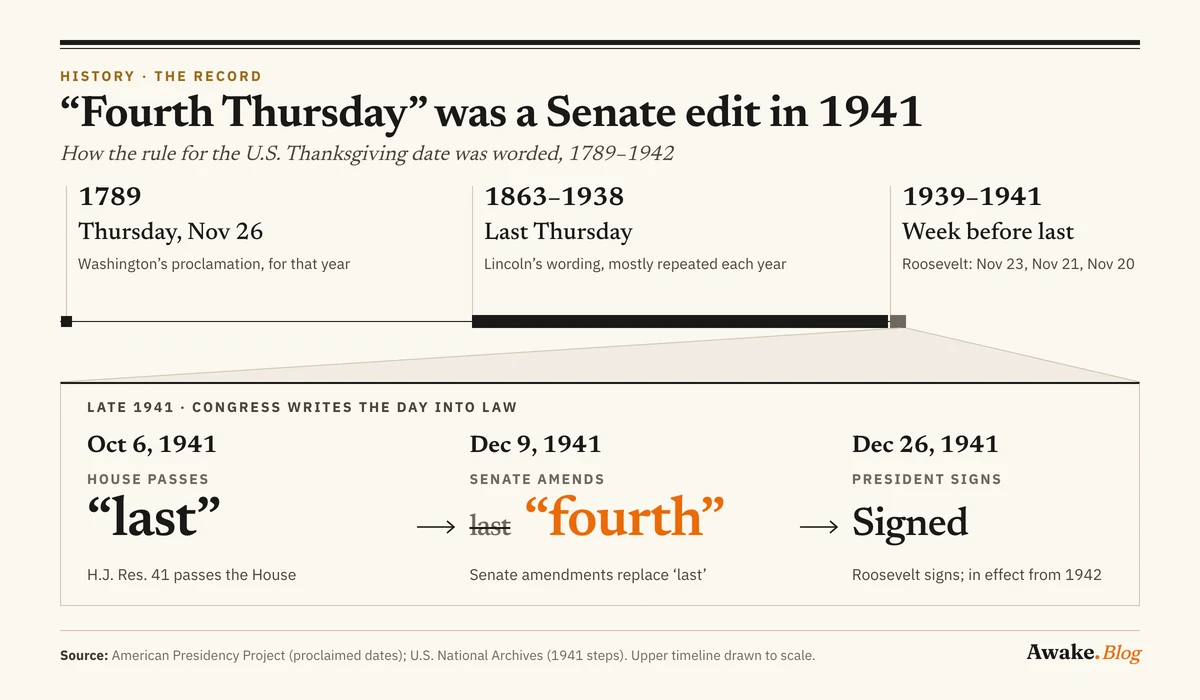
Why “fourth” lands between the two old dates
Every November has four or five Thursdays. The first Thursday falls between November 1 and 7, so the fourth falls between November 22 and 28. The last Thursday falls between November 24 and 30. To find any year’s date, take the first Thursday and add three weeks.
A November has five Thursdays only when November 1 is a Wednesday or a Thursday. In those years the last Thursday is the fifth, a week after the fourth. In every other year the fourth Thursday is also the last one, and the two rules agree.
Setting the three rules side by side shows the effect.
| Year | Thursdays in November | Last Thursday (custom to 1938) | A week before the last (Roosevelt) | Fourth Thursday (law from 1942) |
|---|---|---|---|---|
| 1939 | 2, 9, 16, 23, 30 | Nov 30 | Nov 23 (proclaimed) | Nov 23 |
| 1940 | 7, 14, 21, 28 | Nov 28 | Nov 21 (proclaimed) | Nov 28 |
| 1941 | 6, 13, 20, 27 | Nov 27 | Nov 20 (proclaimed) | Nov 27 |
| 2026 | 5, 12, 19, 26 | Nov 26 | Nov 19 | Nov 26 |
| 2028 | 2, 9, 16, 23, 30 | Nov 30 | Nov 23 | Nov 23 |
Proclaimed dates from Proclamations 2373, 2441 and 2522 (American Presidency Project). Other cells are worked out from each year’s calendar.
In a four-Thursday November, the fourth Thursday is the old last Thursday. In a five-Thursday November, it is Roosevelt’s earlier date. The Senate’s recorded reason mentions only the five-Thursday years. Read against the calendar, “fourth” gives each side its date in a different kind of year, but the record does not say senators intended that balance.
The fixed range has a plain consequence. Under the 1941 wording, Thanksgiving can no longer fall on November 29 or 30. The most recent split year was 2023, when November 1 was a Wednesday. The holiday fell on November 23, a week before the old rule’s November 30. The next is 2028, whose Thursdays land on the same dates as in 1939. Thanksgiving that year will be November 23, while a last-Thursday rule would have said November 30. In 2027, both give November 25.
What the record leaves open
The state counts are partial. They stop at 1940, so they do not show what states did in 1941, or how quickly every state’s own holiday matched the federal date after 1942.
The years before 1939 have a gap of their own. The Archives’ “for the most part” leaves room for years when a president named a different day, and the sources used here do not say which years those were.
To find any year's Thanksgiving, take the first Thursday of November and add three weeks; it always lands between November 22 and 28.